Showing posts with label Claude Nougat. Show all posts

Sunday, April 6, 2014

Misunderstood Art: Jamie Wyeth's Masterpiece in a Closet

In Italy, the best museums are ignored by tourists, in America, a fantastic portrait is relegated to a closet. Only now, it's coming out of obscurity because suddenly the public realizes that Jamie Wyeth, the gifted son of Andrew Wyeth is as great an artist as his father.

Done in 1963 when Jamie Wyeth was still a young upstart, it is the portrait of a famous woman doctor, universally considered a pioneer and the founder of pediatric cardiology, Helen. B. Taussig (for her biography, click here). She was a strong woman, extraordinarily bright and gifted, and it shows. The portrait is an amazing psychological analysis as well as esthetically remarkable - the colors, the rendering of the flesh, the striking blue eyes, the fuzzy hair:


And here's the portrait's story in the Johns Hopkins Magazine published in 2011 (it shows the above photo of the portrait), to see click here. 

This week the New York Times picked the story up again as now the artistic value of the portrait is finally recognized because Jamie Wyeth has finally achieved fame, see here.

Why all the fuss?

Because, back in 1963, the good doctor and her friends at Johns Hopkins didn't feel the painter had done justice to her. She was universally seen as a good woman - and she was, no doubt about that - but the painter had caught something that was not so visible to everyone: her determination, her strength, her keen intelligence and capacity to observe/analyze, and also the angst that inevitably accompanies pioneering work. What eyes!

Compare the portrait to her official photo (on Wikipedia and elsewhere):


See what I mean? The portrait tells a real story, the photo tells a cliché version. 

Even a well done but more conventional portrait (made in 1981 by Patric Bauernschmidt - it's shown in the NYT article) misses the point about Dr. Taussig:


What do you think? Is Jamie Wyeth's a bad portrait or a good one from an artistic point of view?

Wyeth has made his reputation as a landscape, still life and animal artist rather than as a portraitist (to see his work, click here)...He complained that people do not see themselves as the artist does and therefore did very few portraits - and I can't disagree with him on that...I've tried my hand at portraits, and there's no doubt that a portrait is by far exceedingly difficult to pull off successfully - and very rarely to the satisfaction of the sitter! 

By the way, that is also a point I make in Crimson Clouds, my novel about a retiree-turned-artist to the dismay of his wife. Portraits are psychological exercises, tough to carry out and particularly tough when it's a self-portrait: it's very hard to see oneself objectively!
Enhanced by Zemanta

When an Audio Clip Turns Into a Radio Show...

Fantastic job done by the Director of the HighRock Institute Joel Scott and his partner Angela Castonguay. This is a fiery dialogue taken from CRIMSON CLOUDS, my just released romance. What was going to be a sample audio clip was suddenly turned into something quite different, like a radio drama show, with two beautiful voices, male and female, screaming at each other...You can hear it directly on Sound Cloud here , or click below:
 
 
Congrats to Joel and Angela! I highly recommend them, they did a superb job, don't you agree? If you want to use their services, click here to contact them, you can read their latest blog post on audiobooks, "does an audiobook make sense for you?", click here.

Listening to that dialogue, think of Robert looking like (ideally!) George Clooney:


And Natasha like Julianne Moore:


Are you wondering what happens next? Is Robert going to get back to Natasha or will other women enter his life? And what about his wife? If you're curious, you can get the book here. 

Looking at the future of audiobooks:  the dialogue you just heard was extracted from Chapter 16 and of course, in the novel, it's embedded in the text that describes the reaction of each character. However, using more than one voice to read from a book opens up the possibility of theater-like dialogue that, in my opinion, is far more effective and lively than a straightforward reading of the book. 

I wonder whether audio-books could be systematically done that way...though it would require extra editing from the author because of the need to turn the dialogues into self-standing pieces and of course, it would require a high level professional reading perfomance. 

This suggests that novels re-formatted that way  would stand half-way between theater and straight fiction.

What do you think, would that editing effort be worthwhile?It could be the start of yet another way for telling a story, an alternate format...


Enhanced by Zemanta

What You Learn in Your 60s...

So many 50th anniversaries of Baby Boomer milestones to celebrate these days, from the Beatles appearing on the Ed Sullivan Show fifty years ago to President Kennedy's assassination. And expect a lot more, since the Baby Boomer generation spans 18 years of history (1946-1964). Moreover, in 2014 all boomers, even the youngest ones born in 1964, are passing the 50 mark and most boomers are now facing the transition to the second act in their lives.


I'm Happy Just to Dance with You

Time to figure out what the sixties decade means!
Warning: what I’m going to say here is based on my own experience (!). When I left behind a lifetime career at the United Nations, I thought I was going to enter into a wonderful period of R & R (rest and recuperation). Hey, I deserved it! But no, it didn’t pan out. Too much to do. There was my writing, I wanted to revive my childhood dream of becoming an artist. But I hadn’t stopped being a wife, a mother (two grown-up children) and…a daughter. My Mom, 100 years old and still thriving (she reads one novel a week on her Kindle but I'm the one manipulating the ereader to buy them).

So here goes. 
  • The biggest transition is realizing that you're the "sandwiched generation". In spite of all the hype about how rebellious Baby Boomers have changed History, the truth is very different. Most of us are not into politics or big events. We find we are responsible for both our old parents and our children. The parents may not be in their dotage quite yet, but they need care. Our children in some cases may still be toddlers (a result of the fashion for late marriages), but for most of us, they are grown-up. With the on-going recession, chances are they’re home, struggling to find a job. As parents, we are happy to have them around, but it's impossible not to worry about their future.
  • You've finally know the distance between the real world and the ideal one. The distance is big and no one can pull a fast one on you.
  • There may be no "soul mates", you've known there weren't since you were in your 40s, but you can distinguish between your real friends who will help you and those who won't. This is perhaps the most surprising thing: it's still possible to make new friends in your 60s.
  • You learn more about yourself, more than you ever thought possible. The last time you learned so much was back when you were in your late teens and early twenties. That's exhilarating. And frightening. For us writers, that transition to greater self-knowledge is a fantastic fount of inspiration to write novels (indeed, that's what inspired Louis Begley with his About Schmidt series, Deborah Moggach with The Best Exotic Marigold Hotel  or my own Crimson Clouds, a romance featuring a man who’s just retired).
  • On a lighter note: You see the good side of things more easily than before. You've learned to appreciate the simple things in life and honest friendship - because now you trust your judgment and you know you're not going to live forever. Carpe Diem! Catch the joy in each day and spread it around.
  • On a yet lighter note: Now you can buy those tight jeans, you've learned to control your weight (about time too!)
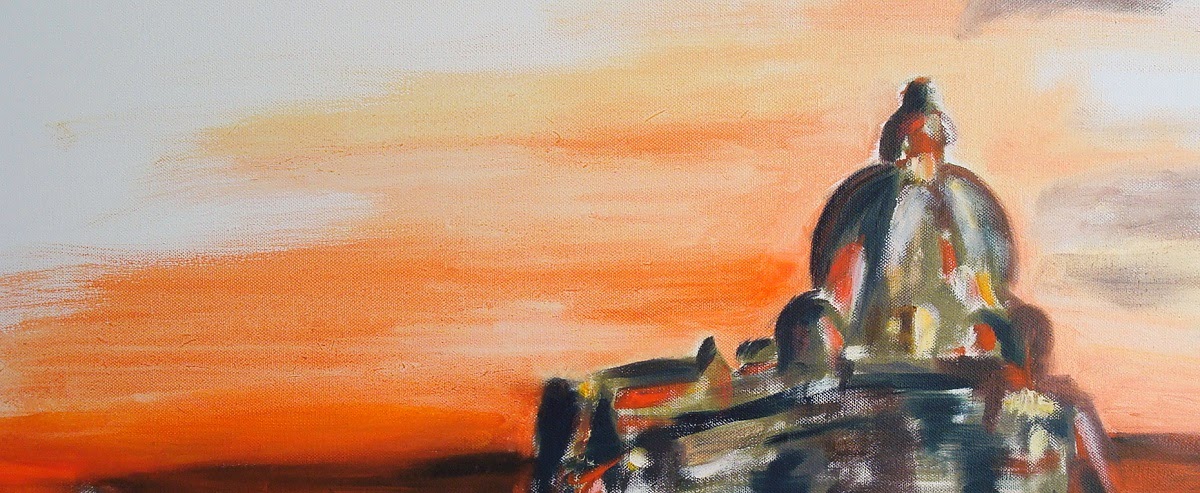
In short, the end of the day is perhaps the best moment, full of colors, more awe-inspiring than any other moment in the day except for dawn. 

The end is like the beginning, full of promise!

Oil painting by Claude - Sunset over Rome (2010)

 About Claude Nougat
She is a writer, economist, painter and poet. A Columbia U. graduate, Claude has held a wide variety of jobs before starting a 25 year career at the United Nations, ending as  FAO (Food and Agriculture Organization) Director for Europe and Central Asia.
 
Claude is the author of many books, including two in Italian that won several awards in Italy, and six books in English, all fiction except one essay on development aid; she is considered a prime exponent of Boomer literature. Her latest book, Crimson Clouds, is a romance, tracing the passionate search for self by a man who has just retired from a brilliant career and the desperate efforts of his wife to save their 20-year marriage. Her poetry has been included in "Freeze Frame", a poetry anthology curated by British poet Oscar Sparrow and published in 2012 by Gallo-Romano Media.


Claude is married and lives in Italy.
Enhanced by Zemanta